
22 October 2022
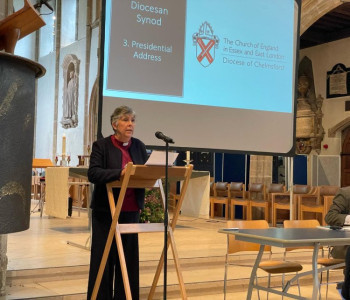
Presidential Address to Diocesan Synod - October 22
Good morning Synod and a warm welcome from me. It’s very good to be here with you. I want to begin by offering sincere and heartfelt congratulations to our friend and colleague +John on his appointment to be the next +Liverpool. You will have heard the announcement, no doubt, on Tuesday. There will be ample time to thank him properly and to say goodbye but for today suffice to say that we’re sorry to be losing you but delighted for you and Jessy, and we’ll be praying for you in the coming weeks.
Much has changed since we last met as a Synod in June. Most significantly perhaps has been the death of the late Queen which has marked the end of an era in this country and in some other parts of the world too. It has led to a period of thanksgiving for a life well lived. The nation has both grieved her passing and reflected on her considerable contribution over a 70 year reign.
Thank you to all of you who worked hard over the two week period of mourning to ensure that our churches were open, offering the opportunity for individuals to express their grief through private prayer and for communities to gather for memorial services. I know that navigating some of the practicalities will have added additional stress and pressure but once again the public response demonstrated how important the role of the church is in times of personal and public grief. I’m grateful for the part that each of you played.
And, of course, we now have a new King, Charles III. So, a time of change and transition for him, for the Royal Family and for the country, all of which need our prayers.
Meanwhile, many other challenges continue to swirl around us – the Government once again in deep in crisis with the resignation of the Prime Minister on Thursday; the exponential rise in the cost of living, causing enormous anxiety with predictions of poverty levels that will impact the lives of far too many people and will, in turn, have implications for an already stretched NHS and other public services. The war in Ukraine continues to rage, too, and the refugee crisis worsens across the globe. And the scenes we are witnessing from events in Iran are a reminder of the brutal injustices that affect so many around the world.
And amidst all of this, and much more, what is our reaction? What is our calling? Well, it is, I believe to continue being God’s people. To be those who live by and share the good news of Jesus Christ, who hold before others the flickering light of hope and are emboldened to pray and work for change where we can.
It's vital for us to acknowledge these painful and intractable national and international events as the backdrop for our Diocesan life together. For this breadth of vision serves as a reminder to keep our gaze outwards to the needs of the world and the people amongst whom we live, and to sit light to our internal problems. I believe our vocation always, in good times and in bad, boils down simply to two things: to continue worshipping faithfully, and serving our communities; or, to use the words of Jesus, to love God and love our neighbour.[1]
And how best might we do that? Well, I said in my Presidential Address in June that come the autumn we would begin the process of articulating our direction of travel for this next phase of our life together. And, indeed, we have begun and so I’m going to use the rest of my address today to share with you where we’re at and how I see things unfolding.
You will have heard me say, possibly several times now, that for the foreseeable future there will be no more initiatives imposed from the so-called centre. Everything will be invitational and driven by the local context. The mental image I have is one of seeking to tip the traditional pyramid of organisational hierarchy on its head.
Instead of the Bishop and the Leadership Team propped at the top, making decisions and planning programmes that have to be filtered through Governance structures, Diocesan and Area Staff, eventually reaching the grass roots who are asked to follow suit; instead of that, I’m envisaging that we encourage and empower local contexts, each in your own worshipping communities, to share in the task of discernment and to discover what it is that God is calling you to do and be. How it is that you are to be God’s people, in your part of the world - faithful beacons of love and hope in the context of your communities.
If you choose to engage, our structures and processes will need to change to give you agency and provide support. The lack of a central programme is not the easy option, nor is it an invitation to disengage but, rather, to play your part more fully, with authenticity, appropriate accountability and a real sense of responsibility. It means you can no longer look to the Diocesan Secretary, the Archdeacon, the Bishop or whoever to solve your problems but you can be assured that those of us with wider responsibilities and oversight will be alongside to support you in whatever way we can. I’m encouraging Diocesan staff to think of themselves as support staff, there to enable, strengthen and serve the local context, acting in ways that demonstrate respect, honesty and transparency.
But if we don’t have a diocesan strategy, what – you may well ask – will keep us together? What will enable us to strengthen our Diocesan identity and become more fully the Chelmsford-shaped children of God? Well, for me, this has something to do with our commitment to one another and how we travel together. Again, you’ve heard me say many times, the nature of our relationships, how we travel together, how we journey alongside one another, is far more important than the detail of what we do. It is in the way of pilgrimage that God will shape, bless and use us, so that we might be best prepared for whatever the point of arrival turns out to be.
We don't, any of us, know the future shape of the Church of England, which has changed over the decades and centuries, and will continue to do so. But we do know that Christ who has called us is faithful. He has placed us, intentionally, in relationship with one another to make this journey into the future together, as God’s people. To journey alongside one another, supporting and upholding one another through times of joy, sorrow, loss, disagreement, challenge and opportunity. We are disciples of Christ, called to travel well together, and to glorify the one who has called us to be one body in his name.
So, how might we journey well together? During September, the Area Bishops and I spent some time away over the course of three days. It was good simply to be together, to strengthen our relationships, to share our thoughts about the Diocese and consider the future. We were united in our vision, not to develop a programme or a single strategy but to identify values that will guide and form us.
For this next season of our life together these values will ensure that the emphasis is more on how we do things and less on what we do; though they will, of course, also have the potential to shape the things we choose to do. As bishops we took time to notice that which has been emerging in our shared life as a diocese. We reflected on conversations we’ve had with people across the Diocese, the period of Holy Sabbatical last year and the times that I’ve spent attending Deanery Synod meetings (and these are, of course, ongoing). And we discerned together values that speak of our life of discipleship, values we have seen in practice and values that we believe we’ll need to continue developing.
These values will be tools to help in the task of discernment and will enrich our relationships at every level, from the way in which parishes live out their calling, the deanery relates, Bishop’s Leadership Team operates, the Diocesan Office works, and the way in which we communicate and collaborate across and between these. In the end, the most perfect of structures will not work if the relationships are corroded and it is my hope that the values will help us to build trust and strengthen our life together so that we may be those whom God can use to his glory and to the service of others.
We have shared our thoughts and reflected further with colleagues on the Bishop's Leadership Team and my plan, going forward, is to share in greater detail with Area Deans when the Bishops and I meet with them in November, and to seek their views and insight. From there we’ll need to work out how best to broaden the conversation and communicate more widely throughout the Diocese, working out together how best the values might be practiced and lived. I hope that we can begin to reflect on these values further throughout Lent and through the Bishops Study Day which this year will be led by Dr Jane Williams. So I hope you have the date for that already in your diary.
For now, suffice to say, that if the values approach is to bear fruit, we’ll need, each and every one of us, to engage with them personally, as individual disciples, as well as in our communities and the various groups with which we work. They’ll need to permeate through all we do and are as we seek to become ever more fully those who are “clothed with Christ”[2], challenged, changed and transformed.
Let me now say a word or two about Transforming Presence and in particular MMUs. Both have been an important part of recent times and it’s right and proper that I should address them head on. Again, we talked about this in some depth at our recent BLT meeting where there was agreement that it is now time to move on from Transforming Presence as describing our Diocesan strategy. Not because Transforming Presence and its four priorities (to inhabit the world distinctively, evangelise effectively, serve with accountability and re-imagine ministry), not because these aren’t good things – indeed there’s nothing in them that any one of us would disagree with or wouldn’t want to promote – but because it is now time to build on the foundations of Transforming Presence by emphasising, at a Diocesan level, not what we need to do (that will be articulated locally) but, guided by shared values, how we are to live.
So, for the sake of clarity, we will now stop using the term Transforming Presence at a Diocesan level but if it helps you locally please feel free to continue using it. I have talked often of moving into a different season of our life together and I’m mindful that seasons, at least in this country, don’t usually have clear and definite beginnings or endings. Rather they merge and overlap and I’m more than content to think that way about the seasons of diocesan life. Let’s continue enjoying the fruits of Transforming Presence even if we are moving towards a different articulation of our priorities.
Transforming Presence also saw the development of Mission and Ministry Units. At the heart of the creation of MMUs was a strategy to reduce isolation in ministry and encourage partnership, both good and noble aims that we mustn’t lose sight of. However, the expression of our shared life and ministry has many different forms through deaneries and benefices, as well as MMUs. In moving on from Transforming Presence, we’ll also be moving on from the creation of MMUs as a diocesan wide strategy. There are places where MMUs have brought, and continue to bring, renewed life through the recognition of a depth of partnership, but there have been other places where their creation has simply not been possible.
While we may be moving on from Transforming Presence and MMUs as a diocesan strategy, let me reiterate that the future is still about partnerships. We must continually guard against isolation and the silos which risk separating the body of Christ. To do that well we must attend to our relationships. Where MMUs have flourished, they’ve reflected a depth of relationship and partnership. It's fair to say, I think, that the term 'Mission and Ministry Unit’ doesn't quite evoke the idea of relationship, speaking more to structure and process. And so I was interested to hear the other day that the use of 'Unit' in MMU was originally meant as a working description, which somehow never got changed.
Notably some have opted to use the term Mission and Ministry Partnership (MMP) which probably better describes their intention of deepening relationship and mutual support. As we seek to travel well together, I encourage you to continue thinking about and exploring ways in which you can work well with one another, whether through deaneries, MMPs, or benefices, to continually reach out across traditional boundaries and in ways that enhance our life together.
In conclusion, then, let me emphasise again my conviction that we are being called to attend more to how we travel well together, at local level, diocesan level and in every other way you can think of. At the same time I want to encourage local contexts to share in the task of discernment, to discover and articulate what it means for you to be God’s people in your communities and how you might work in partnership, using as the basis for your discernment some shared values, alongside appropriate support from the Diocese, about all of which further details will follow in due course.
Everything we do must flow out of what we believe, rather than from a set of instructions we are told to follow – rooted in Jesus Christ, authentic faith, leads to authentic communities and authentic action. I was struck recently by some words of the late Archbishop John Habgood. In an essay on evangelism and included in a Newsletter to his Diocese while he was Bishop of Durham, he wrote: “Evangelism is not an obligation because somebody says we ought to evangelise. It is what happens when we look at the tragic-comedy of the world, and yet dare to believe that God has entered into the mess and muddle in order to transform it.” And in the words of Joan Chittister, author of The Monastic Heart, “… everything we need to sustain us on the path is with us already. That’s what we praise and pray for.”
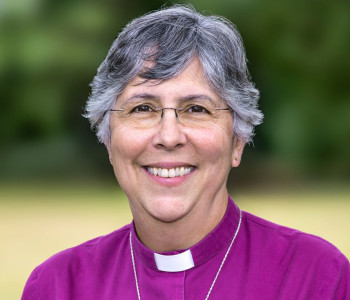
+Guli Chelmsford
Diocesan Synod Presidential Address
22nd October 2022
[1] St. Mark’s Gospel chapter 12,
[2] Galatians 3. 27.