


“Supervision is a structured process of reflective learning in which a supervisor meets with a supervisee to develop and support learning skills, understanding, and good practice. It will take place within a framework of spiritual understanding and prayer, care, trust, and openness.”
It is the expectation within the diocese that lay and ordained ministers will have regular meetings with a colleague in their benefice or MMU in which they can discuss their work challenges, role, and current ministry to enable greater insight, shared responsibility, and developmental support as well as practical actions needed. Licensed Lay Ministers are often the most appropriate supervisors for other lay ministers. Note that in a vacancy, the Churchwardens exercise leadership in Mission and Ministry within the benefice, so there is a measure of oversight from them with regard to all the ministers who serve there - however, this does not amount to formal supervision.
This is to assist in breaking down the isolation that many feel in ministry and to develop collegial approaches. The timing and frequency will depend on the amount of time devoted to a parish role, and whether there are also shared ‘team meetings’ with others for planning or group supervision, but a diaried weekly meeting is appropriate for stipendiary curates, a monthly meeting might be a reasonable expectation for others in ordained or licensed roles, and every three months might be appropriate for those in authorised roles. Annually the working agreement should be discussed, and revised if necessary.
Good Supervision offers space
- To be ourselves
- To dream dreams and reconnect with our vocation
- To admit tiredness, weakness, failure, disillusion, ambition, hope, confusion
- To be heard and have our work valued
- To be challenged
- To examine the gap between our intentions and our practice
- To allow God to work through us by honest interaction with one another
‘Supervision, in a non-managerial sense, creates a confidential space which is spiritually and theologically rich, psychologically informed, contextually sensitive and praxis based. It fosters a growth in both vocational identity and professional practice. It can explore issues of skill development, management of boundaries, professional identity and the impact of the work upon all concerned. It is a very useful discipline to support those in ministry and mission.’
Revd. Duncan Strathie, Diocese of Salisbury handout.
Curates are encouraged to think about how to use supervision well within their Induction day and IME 2 programme, and expectations about supervision for curates are set out in the IME Handbook.
For a reminder of some of the content, click on the pdf here:
Supervision and the Three-Legged Stool

In the Diocese of Chelmsford, we believe it is important that supervision is
Formative: aiding the supervisee’s growth and development
Restorative: supporting them personally and pastorally
Normative: setting out legal framework, the policies of the organisation, and the standards expected
Supervision and the Discipleship Square
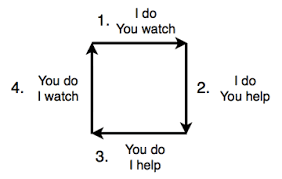
In the Diocese of Chelmsford, when we speak about supervision we also speak about "gradually increasing autonomy".
1. When a new minister starts out, they will need their supervisor to model good practice. So this may mean that
*the leader of a sidesperson team demonstrates what a good welcome looks like at the church door,
*an LLM supervising a new Authorised Local Preacher does their own share of preaching, or
*a Training Incumbent with a new Curate models what leading a good funeral will look like.
2. Next, it will be appropriate for the supervisor to be quite directive in the delivery of the ministry, alongside their new colleague. In the three examples above, this might mean
*the leader of the sidesperson team is present with the new team members and directs them as to where to stand and how to interact with newcomers,
*the LLM works with the new preacher quite intensively - this may involve "co-preaching" with them, or working with them to craft the sermon (perhaps asking for a script), and giving detailed feedback afterwards, or
*the Training Incumbent leads a funeral, but asks the Curate to (for example) preach the sermon and lead the prayers for those that mourn.
3. It's crucial that we move from stage 3 to stage 4 at an appropriate time - too quick a move to this stage will overwhelem the trainee, too slow a move will exasperate them. In this stage, the "supervisee" has appropriate autonomy, but the supervisor is on hand to assist. So in the three examples,
*the sidesperson team will act autonomously, with occasional informal feedback from the team leader and intervention only if something is clearly detrimental to the smooth functioning of the church
*once the new preacher has preached three or four times, the LLM offers informal feedback to the new preacher, but no longer expects to see scripts or be pre-briefed on what will be said
*the Curate leads a couple of funerals, but with the Training Incumbent present; the TI might (say) lead the prayers, and will give feedback afterwards.
4. Finally, we aim to reach a point where there is fairly full autonomy. To use our three examples,
*the sideperson teram is now trained and effective. "Supervision", in this context, simply means having a supervisor who is alert to issues and always available for the supervisees to talk to, and who convenes the team every (say) six months to check how it's going and see if the team can be developed further
*the LLM makes themselves available for the Authorised Local Preacher to approach at any time, and meets with them every three months to give feedback and encouragement, or
*the Curate is trusted to lead funerals by themselves, but continues to meet for supervision with their TI reguarly and reflects with them on how their fuineral ministry is going, and any particularly complex funerals.
Reading:
Pastoral Supervision, A Handbook, Jane Leach and Michael Patterson, SCM, 2010
Lifelong Learning, Frances Ward, 2005
Theological Reflection Methods, Elaine Graham, Heather Walton and Frances Ward, SCM, 2005.
Beyond the Diocese further training and accreditation can be undertaken through various organisations and agencies: https://www.pastoralsupervision.org.uk/training-providers/