


6 June 2026
The Presidential Address to the Chelmsford Diocesan Synod, 6 June 2026, by the Rt Rev'd Dr Guli Francis-Dehqani, Bishop of Chelmsford.
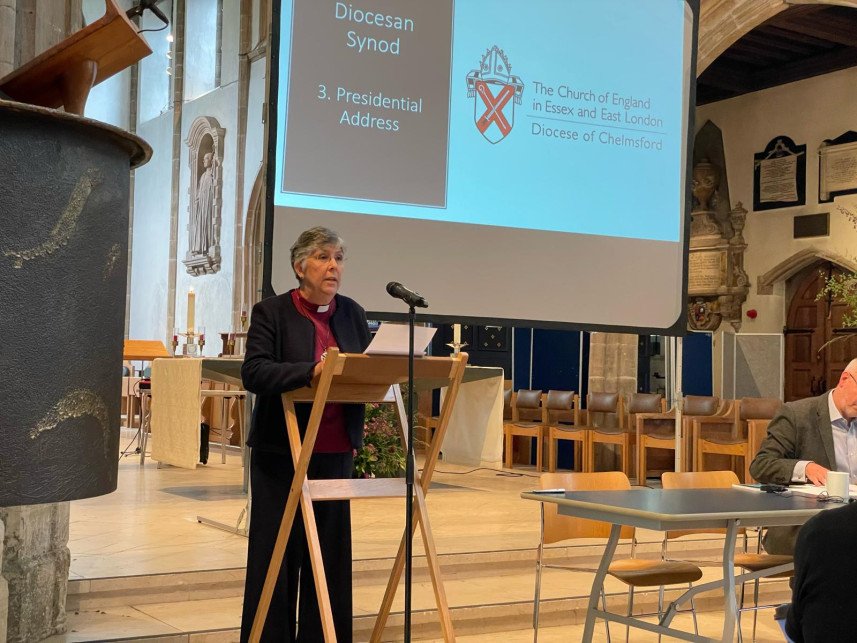
In my last Presidential Address, I suggested that it is sometimes incumbent on us to lift our eyes above the horizon of our own lives and priorities and to notice the world that God is looking upon. On that occasion I was talking about the situation in Iran and the Middle East.
Today I want to invite us to notice God’s world in a different way. I’m inspired in part by all the many events recently, celebrating the 100th birthday of Sir David Attenborough in May. If hundreds, if not thousands of others, can mark the occasion, why not Chelmsford Diocese. So this is my small and slightly belated offering.
David Attenborough is certainly someone who has spent a life time noticing God’s world. Through his broadcasts over six decades, he has made an extraordinary contribution to opening the eyes of millions of others to what we might call the wonder and blessing of God’s Creation.
However, in recent years Sir David has not only noticed and described the natural world but raised the alarm about what it is he’s seeing. He recently observed: “We have allowed our natural world and climate to reach breaking point,” explaining further: "We are facing a man-made disaster of global scale. Our greatest threat in thousands of years is climate change. If we don’t take action, the collapse of our civilisations and the extinction of much of the natural world is on the horizon.”[i]
In 2018, in recognition of his contribution to raising awareness about our environmental crises, the British Antarctic Survey named a ship after Sir David. This ship continues the Survey’s groundbreaking contribution to the scientific evidence of human-induced climate change, now accepted by over 99% of studies published in the field.[ii]
Alongside this science there is also mounting evidence, across all continents, about resulting wildlife loss, mortality and morbidity. Our Diocesan Lent Appeal this year focused on the effects of climate change in Kenya and the efforts to support some of those most impacted. In May, parts of Asia experienced unprecedented temperatures of 45-50 degrees causing multiple health and other problems especially amongst the most vulnerable, those who work outside, and those living in inadequate houses.[iii]
Closer to home, the UK also saw May temperatures break new records. Climate change is affecting rural communities; Tom Lancaster, from the Energy and Climate Intelligence Unit, said, “2025 has been another torrid year for farmers in the UK, with the pendulum swinging from too wet, to too hot and dry…. four fifths of farmers are now concerned about their ability to make a living due to the fast-changing climate.”[iv] Essex has one of the longest coastlines of any UK county, and as a result of climate change, is experiencing much faster coastal erosion, for example in Walton on the Naze.[v]
In response to the threats of climate change, in 2020 the General Synod adopted an ambitious (some would say unachievable) challenge: to reach net zero carbon across our parish, cathedral, diocesan and school estates by 2030. It reaffirmed the Fifth Mark of Mission, to strive to safeguard the integrity of creation, and to sustain and renew the life of the earth. And it asked for a plan of action to reach the 2030 target.
Two years later, the Church’s Routemap to Net Zero Carbon[vi] set out a vision for where we could be; it said, “We see a future in 2030 where the buildings of the Church will be warm, bright and welcoming, powered by renewable energy and using low or zero carbon technologies for heat and light. Energy consumption for the Church as a whole will have fallen, on-site renewable energy generation will have increased, travel will be by low carbon means, and carbon emissions will be less than 10% of those now, offset in verified schemes.”
Yet, despite good intentions by the Church and others, including at governmental level - for example, in the Paris Climate Agreement - and backed by mounting evidence of effects, and stark warnings from experts, the world seems incapable of taking sufficient action to prevent the increased destruction and suffering due to our environmental crises. And we in the church are struggling too. Why is that?
Well, in large part because it is very complicated. There’s a lack of human and financial resources in relation to reducing carbon emissions. We’re aware of that even in our own diocese. We know all too well the strain on our financial resources but the issue of human resources also affects our ambitions in relation to the environment. For example, since Sandra Eldridge stepped down from her role as Diocesan Environmental Officer last year, and despite restructuring the volunteer environment team to lessen the work load within the role, and despite our best efforts to recruit, we have not yet been able to appoint a successor.
More widely, structural, regulatory and logistic barriers exist in ensuring the sustainability of new housing and in identifying and switching from investments which increase fossil fuel use. There are also competing priorities such as the cost-of-living crisis; apparent conflicting information about effective actions; and more recently, a changing political landscape with some politicians framing climate action as no more than a lifestyle preference, partisan opinion, or simply “woke.”
Many are now concerned that this political movement will sweep away or, at the very least, slow down any progress made in addressing our multiple environmental crises. In the face of all this, the church must hold its nerve, be ready to speak prophetically, and – in actions as well as words – it must demonstrate hope and faith in God who is Creator and Redeemer.
Some have suggested that the slow response to climate change is because our environmental crises are not primarily scientific but spiritual. For example, the respected American lawyer and environmentalist James Gustav Speth, says: “I used to think the top global environmental problems were biodiversity loss, ecosystem collapse and climate change. I thought that with 30 years of good science we could address these problems. But I was wrong. The top environmental problems are selfishness, greed and apathy, and to deal with these we need a spiritual and cultural transformation, and we lawyers and scientists don't know how to do that.”[vii] Likewise, Rowan Willams suggests that the crisis has “a great deal to do with our failure to think of the world as existing in relation to the mystery of God, not just a huge warehouse of stuff to be used for our convenience.”[viii]
So how do we, as people of faith, respond to the idea that, at its root, this crisis is spiritual and cultural? Our starting place must be to see creation as sacred rather than disposable; as a gift rather than our possession. It is only a Copernican-like shift in perception which will lead to a change in priorities and in culture, and an acknowledgement of the need to address financial and regulatory issues on scale and at speed. Ultimately, to understand better the interlinked roots of our different crises is spiritual work. To address the fear that some currently feel is fundamentally a work of love.
In responding to the environmental crisis, as with so much that can overwhelm us or that we struggle with in the life of faith, it’s all too easy to feel guilty because of our failures and shortcomings. But shame and self-reproach are destructive and can lead to paralysis – we are tempted to avert our eyes and imagine that if we ignore the looming problem it’ll go away. If this is how we’re feeling, perhaps it’s time to put ourselves in a place where we can listen and attend to the heart of God. Just as Jesus did, we sometimes need to withdraw from the world – alone or with a group - to reflect, pray, and draw strength to gain a fresh perspective and the courage to return with renewed vision and deeper understanding.
Climatologist Dr Freddi Otto stresses the vital importance, at this crucial time, of keeping a true perspective. She explains that because climate change is a much slower process than, say, an asteroid hitting the earth, we begin to normalise resulting events such as extreme heat waves. She writes: “The planetary apocalypse fails to materialise; local disasters become the new normal.”[ix] Each new record temperature, each wildfire season, each ecological disaster risks becoming just another headline that briefly shocks us before we move on. What once would have alarmed us now barely interrupts ordinary life.
But as Christians we know that Jesus never looked away – he never lost perspective on people’s pain or on the centrality of love. The story of the good Samaritan is a reminder of the imperative to love our neighbours across all ideological, cultural, political and national boundaries.
Moved by Mary and Martha’s pain and his own deep grief, Jesus wept over Lazarus’ death. He wept also over the city of Jerusalem. And he didn’t turn away because he’d seen too many beggars, too many blind people, or heard too many people scoffing at his words and actions. Right to the end of his earthly life, the pain of those final weeks and the excruciating agony of the ending, he continued to love, to teach, to explain, to heal.
While we learn to engage with the pain of the world, there remains, of course, the need to be aware of our own human needs, especially the needs of those already bearing increased pressures and responsibility in many of our parishes. The substantial work of addressing the climate crisis is for governments and nations, for big businesses and corporations. But meanwhile, we can play our part by doing what we can, not worrying about what we can’t. It may just feel like it’s a drop in the ocean, but as St. Teresa of Calcutta said, the ocean is made up of drops. Our small actions can collectively make a huge difference to the health of our planet and to the continuation of life on Earth.
And there are so many good news stories. Nationally, the Church of England’s Ethical Investment Advisory Group, together with the Environment Agency Pension Fund, have used their convening power in the public arena to set up the Transition Pathway Initiative[x] which provides a practical tool for investors to assess and reduce the carbon impact of their portfolio.
Within our Diocese there are churches demonstrating constructive ways to respond to the environmental crises. A number have found that joining A Rocha’s Eco Church scheme is a great place to begin. The scheme supports churches to address practical, spiritual and cultural aspects of the climate crisis, including working together with others, caring for God’s Creation while at the same time building community. For example, two churches currently working towards gold Eco Church awards have formed a “Grow Greener” group with local parish councils and schools, while other churches have strengthened community links through improving biodiversity in their churchyards.
Still others have found creative ways to insulate church buildings cheaply and to reduce substantially carbon emissions; or are managing their investments more ethically. We should be proud that our Cathedral was the second Cathedral nationally to receive a Gold Eco Church Award. I must also add, however, that currently only fewer than half of the churches in the Diocese are registered with Eco Church and only a quarter have achieved an award. Awards themselves are not the end goal, of course, but they are a sign of our intentions and they do inspire hope and progress in caring for God’s creation.
In my work as lead bishop for housing, I’m encouraging churches and dioceses to adopt the recommendations of the Coming Home report. It provides a theological foundation to help Christians see housing as part of the mission and ministry of the Church and goes on to offer five core values for what good housing looks like. One of them is sustainability, based on the fact that people are called to steward God’s good creation.
When it comes to housing, the choice and specification of building materials, the source and conservation of energy, and how water and waste is managed should all work with, not against, nature. This reflects the calling of human beings as co-creators with God, responsible for looking after the world and passing it on to future generations.
Synod, addressing our environmental crises cannot be left to a committed minority. If nothing else, we can pray and we can talk, in our homes, communities and churches. I want to recommend a resource to help your church and your community to think more deeply about these issues. People’s Emergency Briefing [xi] is a powerful 50 minute documentary film, showing the latest climate crisis evidence in an accessible format and featuring interviews with leading experts and reactions by members of the public and celebrities. There are leaflets with more information available on your tables.
Let me close with a prayer written by Bishop Graham Usher, Bishop of Norwich and Lead Bishop on the Environment:
God of life,
we praise you for the beauty of creation,
its richness and variety;
yet, through greed and ignorance,
we scar your world with plastic waste
and throw so much away.
Make us more like Jesus,
treading gently on our common home,
and breathe your Spirit on us,
that we may care more deeply for your Earth.
We ask this through Jesus Christ our Lord.
Amen.
[i] David Attenborough's Final Warning To Humanity | A Life On Earth
[iii] ‘A calamity’: Why is a record heatwave sweeping South Asia? | Weather News | Al Jazeera
[iv] Energy & Climate Intelligence Unit | Summer drought costs UK arable…
[v] The Naze: A Coast Under Threat & the Fight to Save It
[vi] https://www.churchofengland.org/sites/default/files/2022-09/RoutemapToNetZeroCarbonFinal.pdf
[vii] Gus Speth Interview by Earth Charter
[viii] Rowan Williams, Tokens of Trust: An Introduction to Christian Belief, 2007.
[ix] Climate breakdown is an injustice multiplier


